Convenience Advertising Joins OMA in Support of Australia's Independent Audience Measurement Framework
42-year Australian media company distinguishes independent audience measurement from the science of Attention
Read more

Across Australia, workforce shortages persist in critical sectors including defence, healthcare, education and emergency services, despite some easing in headline labour indicators. Job vacancies remain elevated relative to historical norms, and a substantial proportion of occupations continue to be classified as being in shortage [1,2]. This signals a structural shift in recruitment dynamics: the challenge is not reaching audiences, but meaningfully engaging them in a way that drives action.
In this environment, recruitment must be understood not as a communications exercise, but as a performance system. Awareness alone is insufficient. Conversion is the outcome that matters.
Many recruitment campaigns continue to rely on high-frequency, low-attention environments that prioritise impressions over engagement. While these channels deliver scale, they often fail to create the conditions required for high-consideration decisions. The result is a familiar pattern: strong reach, but low intent; interest without eligibility; applications without progression. This disconnect increases time-to-hire and inflates cost per recruit, reinforcing inefficiencies across the recruitment funnel [3].
This challenge is amplified in government and essential services recruitment. Roles in policing, defence, healthcare, education and corrections require higher levels of commitment, longer decision timelines and greater personal consideration. At the same time, these sectors compete directly with private industry for overlapping talent pools, particularly among younger and culturally diverse cohorts [4]. Workforce modelling indicates that demand in healthcare and care services will continue to outpace supply, intensifying competition for labour and increasing the importance of effective recruitment strategies [5].
High-consideration decisions require time, cognitive availability and trust. Yet most media environments are designed for speed, not depth. Digital placements frequently deliver viewability without sustained attention, contributing to drop-off between initial engagement and application [3]. In contrast, environments that enable uninterrupted exposure and reduce competing stimuli create fundamentally different conditions for message processing and decision-making.
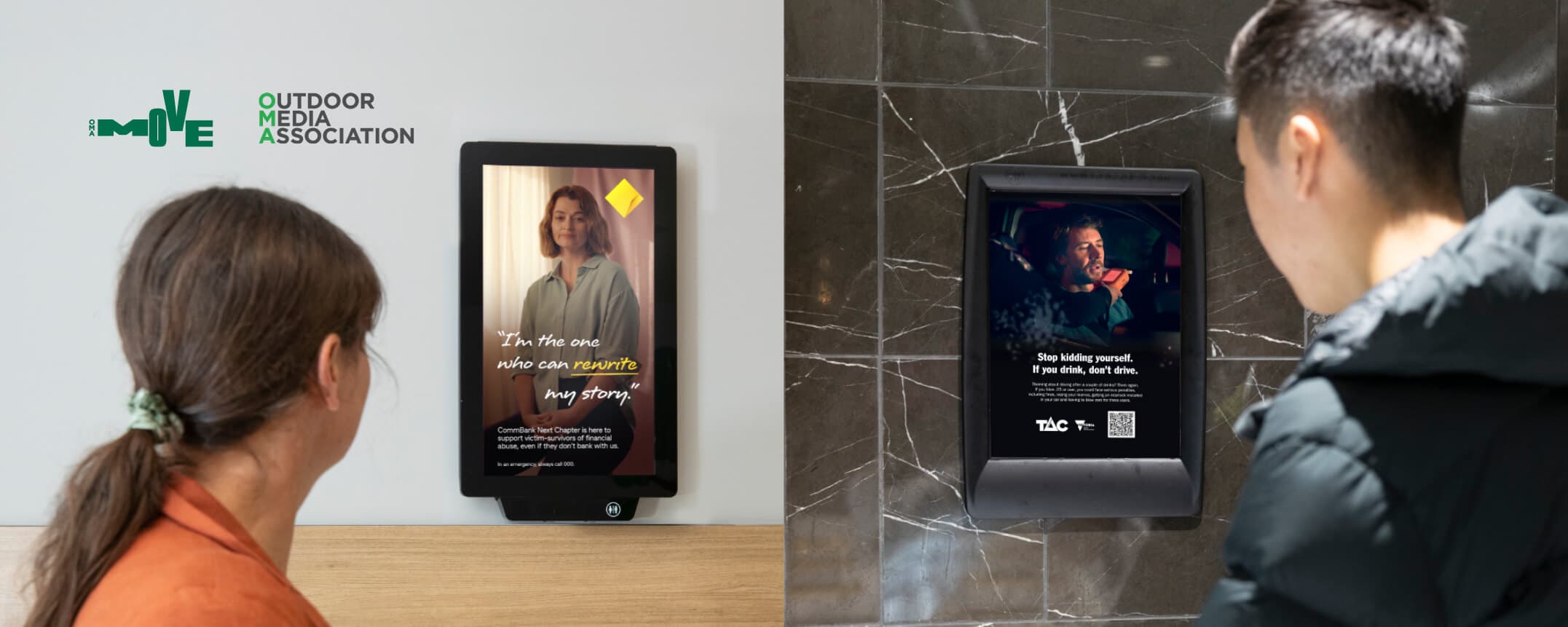
Bathroom-based media environments provide a unique combination of extended dwell time, minimal distraction and inherent privacy. Messages are presented in a setting where audiences are stationary, receptive and able to engage without interruption. This creates the conditions required for more complex messaging, particularly in recruitment contexts where eligibility, expectations and pathways must be clearly understood.
Importantly, these environments also support repeated exposure through routine behaviour, reinforcing familiarity and trust over time. In high-commitment recruitment categories, this repetition is not simply beneficial; it is necessary. Behavioural change and decision-making are cumulative processes, strengthened through consistent, contextually relevant engagement.
The effectiveness of this approach is further enhanced when attention is connected directly to action. The integration of QR codes and mobile-enabled response mechanisms enables a seamless transition from offline exposure to online engagement, reducing friction within the recruitment journey and enabling real-time measurement of intent and progression.
Empirical evidence demonstrates the impact of aligning environment, attention and action. Campaigns delivered within high-attention environments have generated substantial engagement and conversion outcomes, including tens of thousands of interactions and thousands of completed applications within defined recruitment periods. These results highlight the importance of not only reaching audiences but also doing so in a context that supports considered decision-making and immediate response.
From a strategic viewpoint, high-attention out-of-home environments complement rather than replace digital recruitment channels. By capturing attention earlier and more effectively, they improve the quality of downstream engagement, reduce attrition and enhance overall recruitment efficiency.
In a media landscape defined by fragmentation and distraction, attention has become the most valuable and least understood resource. The organisations that succeed in recruitment will not be those that reach the most people, but those that engage the right people, in the right context, for long enough to drive action.