Convenience Advertising Joins OMA in Support of Australia's Independent Audience Measurement Framework
42-year Australian media company distinguishes independent audience measurement from the science of Attention
Read more

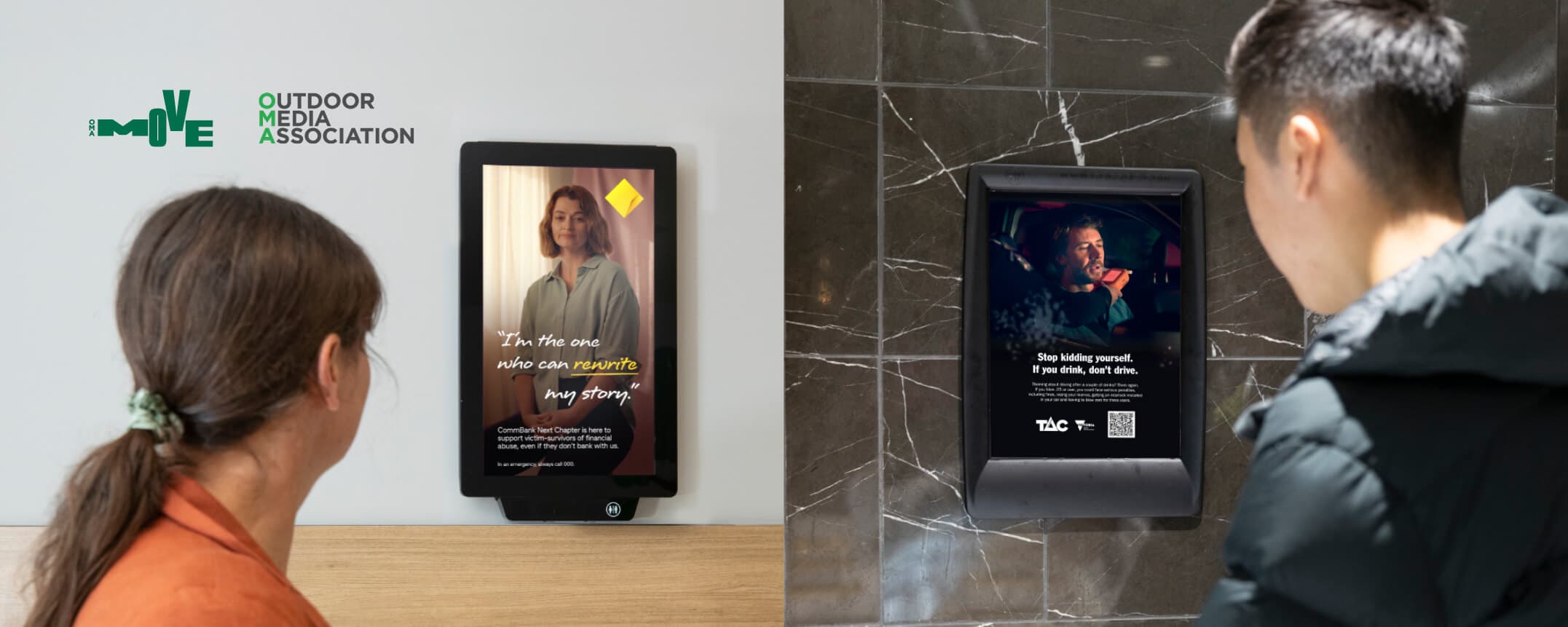
There is a moment, somewhere between washing your hands and reaching for the door, that belongs entirely to you. No one is watching, and no one is waiting for a response. For approximately 151 seconds, the average bathroom dwell time recorded across genders in peer-reviewed observation research [1], a person is alone with whatever they are carrying that day. For mental health communication, this interval is important as it creates a rare set of conditions; sustained attention, low social surveillance, privacy and the possibility of a discreet next step.
Mental disorders now account for more than 6% of global disability-adjusted life years and 18% of all years lived with disability worldwide [2]. In Australia, 3,214 people died by suicide in 2023 alone [3]. The rate in very remote communities runs 70% higher than the national average [4]. Men account for most deaths, and young women account for the highest rates of self-harm hospitalisation.
These statistics do not respond readily to mass-media campaigns or GP referral pathways, because both share a foundational assumption: that the person who needs support has already identified themselves as someone who does. They have recognised distress, decided to act, and navigated the costs, stigma, and availability. For a substantial proportion of the population, particularly the men who account for most suicide deaths, that sequence never happens. The gap between need and service contact is not one that awareness campaigns alone can close.
What makes the bathroom different is not novelty as an advertising surface, but the specific conditions it creates. Social surveillance, the awareness of being observed and evaluated, is one of the most reliable suppressors of help-seeking behaviour around mental health [5]. Inside a bathroom cubicle, that surveillance is temporarily suspended. The person is stationary, unhurried, and performing nothing for anyone. In communication terms, this is a cognitively receptive state: the kind of low-distraction attention window that is increasingly scarce in a stimulus-saturated environment.
The 151-second dwell figure matters because of what it is not. It is not a scroll, nor an interrupted pre-roll, nor a billboard glimpsed at 80 kilometres per hour. It is sustained, proximate and private. For content that asks something of the reader, to consider their own mental state, to retain a phone number, to scan a code, the environment does a great deal of work that formal campaigns spend significant budget trying to recreate.
The ABS National Study found that 21.5% of Australians aged 16 to 85 met criteria for a mental disorder in the previous 12 months, rising to nearly 40% among women aged 16 to 24 [6]. The national figure, however, tells a campaign planner almost nothing useful. Distress is geographically concentrated, gendered, shaped by age and culture, and mediated by the social settings in which people spend their time. Campaigns that treat the population as a uniform audience are unlikely to reach the people most at risk.

The four conditions below are the main reasons for this burden, and each one specifies where a message must appear, in what language, and which service it should point to.
Anxiety Often Goes Unrecognised
Anxiety, the most prevalent condition at 17.2% of adults annually, rarely presents in clinical language [6]. People experience avoidance, physical symptoms, and a persistent sense of dread, and the gap between lived experience and diagnosis is why help-seeking is deferred for years. Campaigns addressing anxiety must operate at the level of the symptom rather than the label.
Depression and the Friction of Help-Seeking
In Australia, 4.3 million people have experienced a 12-month mental disorder, yet fewer than half (45.1%) sought professional help, partly because depression itself impairs the executive function required to navigate care [6,7].
The most recent analysis of NSMHW data found the largest increases in mood disorder prevalence concentrated among adults aged 16 to 25, a cohort navigating the intersection of early-onset illness with housing precarity and labour market instability [8]. For this group, a campaign must reduce friction at every step, a single, proximate call to action rather than a multi-stage referral.
Alcohol, Culture, and Invisible Distress
Mental Health & Substance use disorders account for 14.8% of the mental health burden group [9]. Alcohol use disorders resist clinical recognition because alcohol is normalised within the very settings where distress concentrates, in places like the regional pub, the workplace social event, and the sporting club. The relationship between this condition and the others is one of compounding risk, not parallel burden and the venue in which a message appears, therefore, carries particular weight.
Why Suicide Rates Are Higher in Remote Australia
Suicide remains the leading cause of death for Australians aged 15 to 44, with rates for males in remote and very remote areas more than double those in major cities [10,11]. A figure that represents the scarcity of services, the geographical isolation, and the norms of emotional disclosure in regional masculine cultures.
The value of bathroom media lies in reducing friction at the point between recognition and action. Mental health campaigns ask people to do something cognitively and emotionally difficult: notice distress, accept that it matters, overcome stigma, and move toward support. A campaign, therefore, benefits from entering a setting where attention, privacy and self-reflection can briefly coexist.
The bathroom cannot replace formal care, nor resolve structural barriers, including cost, service access, cultural safety and geography. Its role is more specific: it creates a brief, low-surveillance environment where a person can privately encounter a message, reflect on its relevance, and take a discreet first step without disclosing distress to another person. This makes bathroom placement a practical communication layer within the wider help-seeking pathway, not the endpoint of care, but a setting that supports earlier recognition, self-legitimisation and connection to appropriate services.