Family Violence at Christmas and New Year: Why Awareness Matters
Research highlights increased family violence risk during the holidays and opportunities for targeted, discreet support messaging.
Read more

Prostate cancer is now Australia's most diagnosed cancer, its age-standardised incidence having climbed from roughly 111 to 220 cases per 100,000 men between 1982 and 2021. [1] In 2025 alone, an estimated 29,000 men are expected to be diagnosed, and approximately 4,000 are projected to die from the disease, a figure that has continued to grow even as the age-standardised mortality rate has roughly halved since its mid-1990s peak. [2] This apparent contradiction, rising absolute deaths alongside a falling population-level mortality rate, is largely explained by demographic change: an ageing and growing population is simply reaching the ages at which risk is highest, rather than the disease itself becoming more lethal.
The more instructive figure lies in stage at diagnosis. Five-year relative survival for prostate cancer detected at Stage I approaches 100 per cent; for Stage IV, it falls to approximately 36 per cent. [3] Yet only around a third of cases are currently identified at that earliest, most survivable stage. The distance between a near-total survival rate for early detection and a substantially reduced one for late detection is not, in the main, a treatment limitation. It is a detection and, more precisely, a behavioural one.
This is where recent shifts in clinical guidance are notable. Draft national guidelines developed by the Prostate Cancer Foundation of Australia, currently before the National Health and Medical Research Council for approval, recommend that general practitioners proactively raise PSA testing with all men aged 50 to 69, rather than waiting to be asked, and offer a baseline test from age 40 to any man who requests one. For men with a family history of sub-Saharan African or Caribbean ancestry, or who identify as Aboriginal or Torres Strait Islander, groups associated with meaningfully elevated risk, the guidance recommends earlier, two-yearly testing from age 40. [4] The clinical standard, in other words, is moving toward a more proactive and earlier model of engagement. Public awareness among the men to whom it applies has not necessarily kept pace, in part because the channels typically used to build that awareness are not well matched to the nature of the decision being asked of them.
Health campaigns concerning men's health have conventionally relied on channels engineered for broad reach rather than sustained private reflection: television, social media, transit advertising, and digital out-of-home in high-traffic public locations. These environments are high in exposure but low in dwell time: a message competes for attention for perhaps two or three seconds against a dense field of competing stimuli, and whatever attention it does receive occurs in a public or semi-public setting. This is a reasonable trade-off for categories where recognition and reach are the primary objectives. It is a less suitable one for a subject that research suggests men can find difficult to discuss openly even with their own clinician once diagnosed, pointing to a broader reluctance around the topic that likely extends further upstream, to the decision to seek testing in the first place. [5] A message requiring a moment of unselfconscious consideration is, by construction, disadvantaged in a format optimised for speed and visibility.
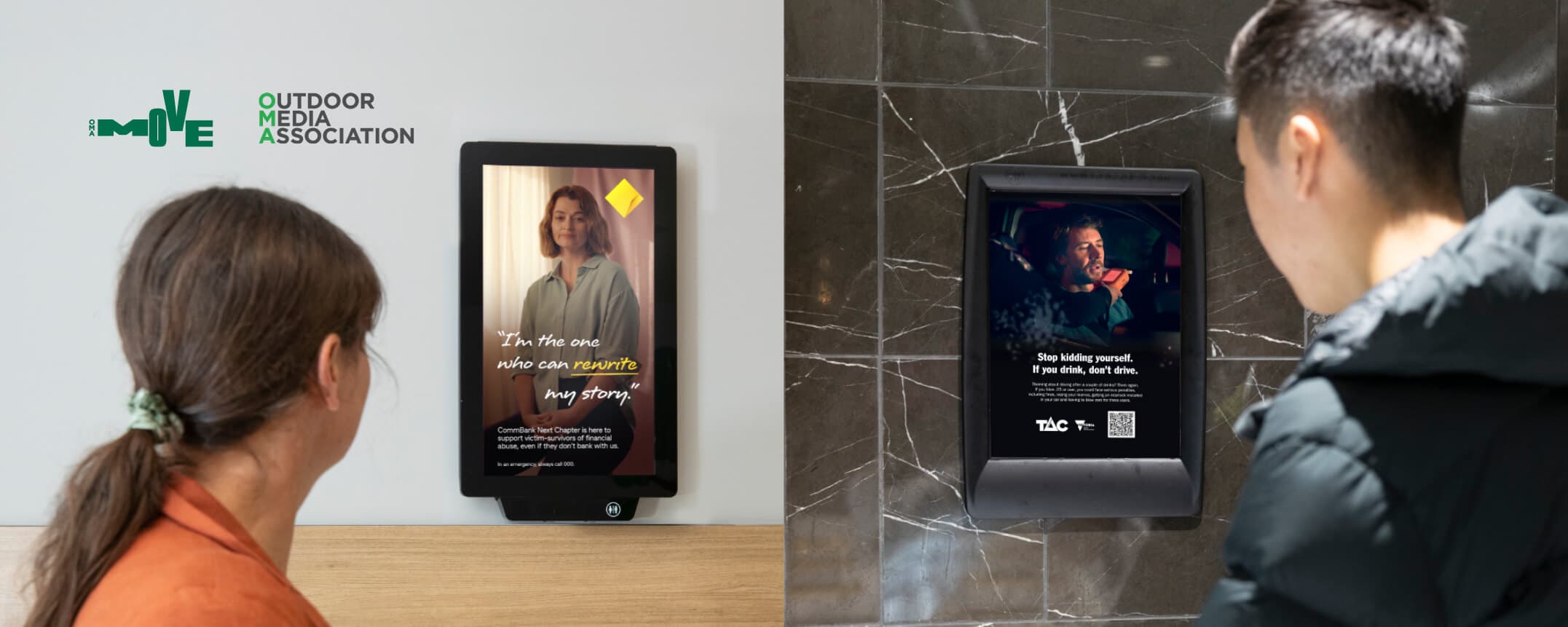
It is in this gap that bathroom-based media presents a structurally distinct proposition. Unlike most out-of-home formats, the bathroom is a private, unhurried, single-gender environment, largely free of competing visual or social stimuli, in which the average visit is documented at approximately two minutes, an unusually long period of undistracted attention by advertising standards [6]. Convenience Advertising operates within this category, with bathroom and parents' room placements across more than 3,200 venues nationally, spanning shopping centres, licensed venues, airports, and education campuses, a footprint that, if considered as a case study, illustrates both the reach and the format-level distinctiveness.
Two established frameworks from behavioural science and marketing theory help explain why this distinctiveness may matter for a message of this kind. Prochaska and DiClemente's Transtheoretical Model describe behaviour change as occurring across discrete stages, precontemplation, contemplation, preparation, and action, with each stage requiring a qualitatively different type of intervention [7]. Many men within the 40 to 49 high-risk cohort remain in precontemplation: prostate testing has not yet registered as personally relevant, irrespective of family history or ancestry. The task facing a first exposure to this message is therefore not to prompt an immediate booking, but to nudge a shift from “this does not concern me” toward “perhaps this is worth asking my doctor about.” A private setting, absent any social audience, arguably offers a more credible context for that early shift than a public one, where any visible reaction to the message carries social cost.
The Ehrenberg-Bass Institute's principle of mental availability supplies a second, complementary explanation. The theory holds that repeated, low-friction exposure builds the associative memory structures that allow an individual to act on a future cue, in this instance, a scheduled GP visit, a prompt from a partner, or the onset of a symptom, long after the specific advertisement itself has been consciously forgotten [8]. Because bathroom networks are tied to venues that men visit repeatedly over time, they can generate the kind of exposure frequency this principle depends on, without needing any single encounter to carry the full weight of persuasion, as a one-off placement typically must.
These theoretical foundations point toward practical implications for message design. Tone should approximate the directness of clinical advice rather than the register of a conventional awareness campaign, naming a specific guideline, for instance, rather than issuing a general call to “get checked,” since specificity appears to do more communicative work than urgency in a category men are otherwise inclined to avoid engaging with.
A scannable code integrated into creative executions can, in principle, convert a moment of dwell time into a concrete next step, provided it directs to something proportionate, a brief risk checklist or a direct booking pathway, rather than a generic informational page. Venue selection, too, may warrant differentiation: licensed venues may reach an older and less health-engaged demographic than shopping centres, which additionally reach the partners and family members whose influence on men's health decisions is well documented, even where they are not themselves the intended test subjects.
Considered together, the evidence suggests that bathroom media constitutes a genuinely distinct behavioural environment for health communication, rather than simply another out-of-home inventory category. For health bodies, government campaigns, and their media partners, the implication is that such channels merit evaluation on behavioural terms, engagement with specific action metrics and stage-of-change indicators, rather than impressions alone, and integration into early-detection strategy alongside, rather than in place of, general-practice-facing and digital initiatives. Given the scale of the gap between early- and late-stage survival outcomes, the channel that helps move a man from precontemplation toward a conversation with his doctor may prove to be as consequential as the content of the message itself.